I thought this was actually great because by the end of the episode he’s met Rosa Parks and Dr. King and he’s empowered with that edification, and it’s I think telling youth of various social groups to learn about and respect those who have struggled to move them forward, to make life better. Down to the “you can serve us coffee because you’re the youngest here” thing.
// “I’ll just have a talk with the bloke at the front and find out where they all drink.” <–nice way to show that Graham “passes” because he’s white and male. He can do everything here easier, even though he’s also a human being grieving his wife. Doesn’t mean his grief isn’t real, just means he’ll never have to worry about being lynched, or even receiving daily microaggressions.
This is so goddamn well done.
Also? The Doctor being HONEST about whether she can change racism for Rosa with a single act of heroic meddling, saying “NO,” is what precipitates Rosa’s righteous anger and allows Rosa to make the history-changing act, and finally, with respect, is not something that Either Russell Davies or Steven Moffatt ever achieved in their writing with the Doctor addressing racism.
Well said! I also love the fact that this time, the Doctor just knew that she couldn’t meddle, that this was a bit of human history that she wasn’t allowed to touch (if not to protect it from Krasko of course). It was in humanity’s hands and she respected that. She didn’t take her agency from Rosa.
YEP.
This has been a consistent theme of Series Eleven and it marks it as different from every other era. The focus isn’t even usually on the Doctor per se. She’s an accommodator, conduit and facilitator, not a “hero” who commandeers the spotlight.
As I said elsewhere, too, in dealing with racism, which is inherently systemic, and not just a matter of individual choices and changes, and must also be changed systemically, and must always be spearheaded by the people of color who are being mistreated, it’s crucial to have allowed Rosa the act of change.
The acknowledgment at the end, that the change was also over a great deal of time, and did not result in perfect circumstances, was also crucial. There was, finally, excellent balance between Rosa’s individual valor and that of an entire movement over many generations.
Tiny nudges, indeed.
//Helping her by not helping her is actually a way to admit with bold honesty that racism is a problem, a real problem you can’t sugarcoat or fix overnight, and that good allies must surrender the podium, stage and voice to the oppressed party. Not surrendering for the path of least resistance, either, or privileging pleasantry over what’s right.
// ._____. Gracie’s death seemed very unnecessary to me. That was what bothered me so much. I feel like women of color already die way too much in Western media….
Agh okay this is all sensitive material, and it’s kind of why I didn’t want to talk about this here, ahhh. Okay. I haven’t articulated myself very thoroughly or well.
@timeviolence I’m gonna be frank with you. I feel the same way about Gracie’s identity as a woman in a caretaking profession whose first impulse is to put herself in danger for others (I do the same thing on an emotional and sometimes physical level in my line of work as a professor and counselor to disabled students–which may be why I was so upset when Gracie died, because I could identify with her personally). I noticed the compelling similarities between her personality type and the Doctor’s. One of my friends even mentioned on Skype the other night how “The Woman Who Fell To Earth” was in fact a double-entendre for the Doctor AND Gracie, both in the literal sense, but also in the metaphorical sense of champions of healing and hope, with the Doctor even absorbing some of Gracie’s personality to “carry with her” in her newest face. I don’t deny any of that. It’s awesome.
We’ve seen it with black women in the past on Doctor Who, in fact: Martha Jones was a medical student, and then a doctor, whose humanitarian impulse I would argue was far greater than the Doctor’s.
But.
Similarly, Martha Jones was treated like shit by the narrative for being in the line of fire helping people (everything from being the Doctor’s rebound girl to being the Master’s target for the psychological abuse of her entire family). The fact that they, and Bill Potts–who was as good as fridged (again, by the Master, tbh) no matter how “happy” her ending was (running off with a water zombie girlfriend she barely knew for eternity)–are all black women who suffer the most egregious fate in Whovian canon. Over and over again. And seeing Gracie die for Graham’s manpain in 11X 01 when Series Eleven was promoted as progressive and fresh and new was kind of a shock of “oh no, this again….”
I guess what I’m trying to say is no matter how many sociology and cultural history classes I may have taken in graduate school, I still don’t have enough LIVED experience of non-white racial identity to comment in a positive way on Gracie’s death. I feel like doing so would make me sound way too much like a devil’s advocate for something that I take for granted as the result of my privilege as a white cis woman (which is NOT to say that if you identify with any of these labels, you are guilty of this: I am only speaking for myself here, and what I’m comfortable claiming).
On the other hand, at least one friend of mine in the DW artistic community who voiced this opinion first is a person of color, and was truly disturbed by Gracie’s death. I feel like I ought to basically say “I don’t know definitively one way or the other,” and hand people like them the microphone on this. I’m not sure of your racial or ethnic background, so you being okay with it could very well be a counterpoint from within the camp of directly lived experience ❤ *thumbs up* And certainly, not everyone who is a poc or specifically black is going to have the same opinion of media representation just because they share skin tone with the character in question. What I’m saying, in a nutshell, is that I am not qualified. So I err on the side of “maybe that wasn’t so cool.”
I hope that makes sense.
Don’t get me wrong anyone reading this, this season has been magnificent and I love it. Still not happy about Gracie.
So, I’m not sure if this is already explained somewhere, but I had a thought about how the Doctor regenerates and how it always leaves them a little…
…loopy.
The Doctor isn’t one to do things by the book, and I think the regeneration process is meant to take longer than the Doctor allows. If we look at another regeneration. In Hell Bent the General regenerates, and says it’s his 10th regeneration. (or he’s currently on his 10th. Either way.) When we see the regeneration process, it’s a lot more controlled than the Doctors.
And after the process is over, the new General is basically fine and right back to business. I think the light that envelopes the regenerating Time Lord is meant to stick around longer and repair the whole body and mind until they get up and carry on. The Doctor is too impatient for that, so as soon as they’re done with the body changing, they just let the rest of the regeneration happen while they’re off on the next adventure.
I might be way off, I admit. But to me it just makes sense that while the Doctor regenerates, all that’s on their mind is…
I dunno I mean when we see War Master/Jacobi!Master regenerate into Simm!Master, he’s dazed for a moment, then he gets up, runs around and has the prescience to hatch an entire evil scheme and (largely) execute it accurately, with only the Doctor fixing his two points of travel to damper it. So you may be on to something with the Doctor’s impatience lol.
//Honestly when the one racer guy tells the story about his mum moving out of the way when he jumps out of the tree and he breaks all these bones and she says “now you know you can never trust anyone in this life,” and the Doctor looks visibly disturbed, I think it goes beyond what any compassionate person would feel hearing that story. I think it’s
1) remembering how detached Time Lord loom parents were, grooming children of the Great Houses for glory but never showing any affection and 2) thinking about how this kind of teaching shaped the Master/Missy.
There are echoes of the Master/Missy in this season, without ever directly referring to them, and I love that.
Shout out from the bottom of my lungs A plague on both your houses This thing It’s a family affair It’s drawing out my weakness
Big boys don’t cry They don’t ask why
There was a time when a moment like this Wouldn’t ever cross my mind The sun will rise with my name on your lips ‘Cause everything will change tonight
I want to be back on the ground Where my feet touch my shadow I want to dig my heels in the dirt Feel it break between all of my toes Anything to stop floating ‘round Bring me down Back down below, oh, oh, oh, oh
Take breath And push the anger down Try to remember calmness
Big boys don’t cry They don’t ask why
There was a time when a moment like this Wouldn’t ever cross my mind The sun will rise with my name on your lips ‘Cause everything will change tonight
Hey now What’s the gravity upon your face So I’m the one who’s bleeding Real men Always thinkin’ with our fists My turn to be the victim
Big boys don’t cry They don’t ask why
There was a time when a moment like this Wouldn’t ever cross my mind The sun will rise with my name on your lips ‘Cause everything will change tonight
There was a time when a moment like this Wouldn’t ever cross my mind The sun will rise with my name on your lips ‘Cause everything will change tonight
((Is this from the new album, Wide World??? How did I miss this song?! It’s truly perfect.. I have never thought about this but the way this song addresses the intersection of repressed emotions, excessive aggression, and toxic masculinity, and shedding these things in order to properly grieve, really apply to Simm Master…..))
Okay SO? This is actually a lot more than even the superficial comparison, which bless you, OP, for making.
I’m an art history professor so bear with my nerdgasm.
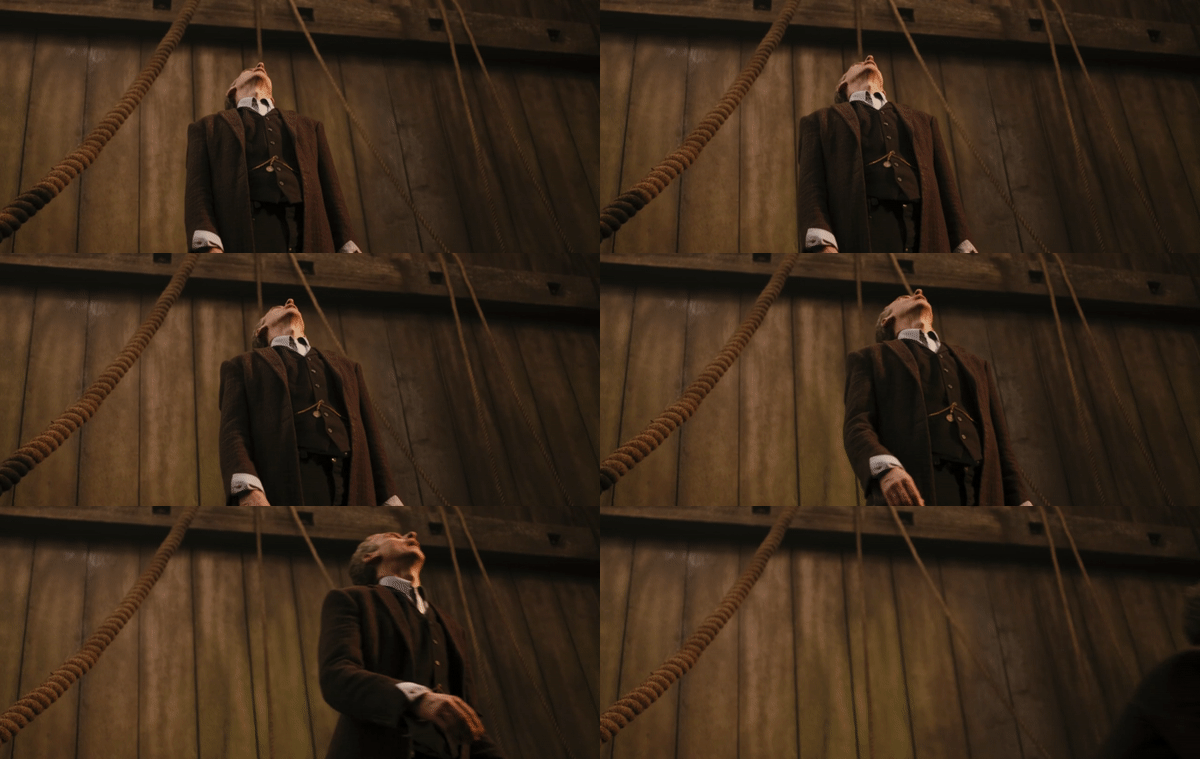
The title of the painting is Wanderer Above A Sea of Mist/Fog. It was painted by Caspar David Friedrich in 1818. Friedrich was a German Romantic painter and it’s crucial to understand the landscape painting movement for which he was famous, to grasp what the cinematographer shooting this scene of the Doctor was trying to imply.
The title itself is indicative of the Whovian genre: “I’m just a traveler,” the Doctor claims, when her newfound friends laud her for her aid and efforts. This is actually extremely compatible with the Romanticist genre, which encompassed writing, philosophy, and art in the late 18th and early 19th century, from which other movements, such as Transcendentalism, sprang. It’s a response and a foil to the Enlightenment, generally agreed to have been fathered by the German philosopher Immanuel Kant, who argued that self-governance and individual, Reason-guided moral compass should take precedence over institutionalized thought (both church and state). Romanticism as a foil to the Enlightenment posits all of the strange, unique/baroque, eccentric, uncontrollable, ineffably powerful and sometimes terrifying qualities of the human experience (largely emotion-driven) are crucial to a fully enriched life. This lended itself well to landscape painting, which served as a metaphor for the human psyche, and the full gamut of human emotion (including the bad stuff–rage, fear, grief, loss) in the form of untamable natural phenomena like storms, oceans, fires, earthquakes, waterfalls, etc.
A particular subgenre of Romantic landscape (and of Romanticism) is the Sublime: that which cannot be categorized or fully understood when experienced, that which is awesome and unknowable, simultaneously beautiful and overwhelming (even frightening). Think Niagara Falls. It’s beautiful, but huge and very loud, and if you tipped over into it, you could drown. Now translate that feeling to a painting, and you have a Sublime Romantic landscape.
Which brings us to Friedrich, who often married Christian religious ideology with the worship of the Sublime in nature. Here he is showing us an anonymous man, unknowable, his back turned to us, having climbed a mountain to view the mighty range, partially obscured by fog. He BEARS WITNESS AS THE VIEWER BY PROXY to nature’s–to the world’s, to LIFE’S–amazingness. In the ACT OF LOOKING, he provides us with a CONDUIT for our own wonder.
“We’re all capable of the most incredible change.We can evolve while still staying true to who we are. We can honor who we’ve been and choose who we want to be next.” –the Thirteenth Doctor, Series Eleven Episode 1, The Woman Who Fell To Earth. ❤
That aside, it’s not at ALL a dumb question. It’s one I grappled with a lot after The Doctor Falls aired. It was truly devastating to me to watch character regression of that magnitude, after End of Time. But I don’t believe that it’s evidence that the Master is actually “a worse person” than he appeared to be during the RTD era so much as it’s a difference of how to frame his character. RTD liked to use dark whimsey, and Moffat was more into flashy grimdark dramatics that translated less well from a previous era’s Master (he also pushed, perhaps a little too obviously, and forcedly, Missy’s redemption at ANY prior Master’s expense, when I always thought Missy’s evolution as a person was obvious without throwing any other Masters under the bus).
Additionally canon hints that during the briefly mentioned period during which the Master was on Gallifrey, Rassilon certainly didn’t let him get away with assaulting him with intent to kill, without some kind of punishment, likely both physical and mental. And by mental I mean involving Time Lord psychic energy, memory erasure, and distorted memories and perceptions. Rassilon and the Time Council deeply feared and loathed the Doctor and the Master and were keen on maintaining what Rassilon himself referred to as the “Enmity of the Ages” between them, because they have long been the most notorious rebel outcasts of Gallifrey’s Great Houses. The Master referred to his exile from Gallifrey as a “mutual kicking-me-out” which confirms this notion that friction existed between himself and the Time Council, probably after they conducted all kinds of memory distortions to delete his memory of the truce he and the Doctor arrived at.
I also believe that Simm Master doesn’t want to “Stand with” the Doctor not for wholly selfish reasons, but also because he has come to see doing so distortedly (and sometimes with the aid of the Doctor’s own actions, with Missy) as equivalent to total surrender. To losing who he is completely, and to becoming a fill-in replica Doctor. This is because his mind is highly sensitive and permeable (he has always canonically proven to be especially gifted at Time Lord telepathy–all those “you will obey me!” sequences in Classic Who) to the will of others and he has had to force himself to block out the person who has always mattered to him most (The Doctor). Some of these ideas are not just my own. @natalunasans can point you to her friends who brought this up incredibly articulately, and @trionrevolutonary has some of their own theories as well. You might also talk to @alez-on-mars and @doctamastacanon who share a LOT of my qualms with The Doctor Falls.
Primarily, I believe this was a case of clumsily handing off a villain from a VERY different past era of the show to a present showrunner, for the sake of the novelty of a double-Master episode, and while the idea was wonderful, the execution was just slightly off, and nobody suffered for it more than Simm’s Master.
He was largely in character, in terms of details, but in terms of the larger character, it felt very much like someone replicating an old painting, but with an old photocopy of the original that made all the colors of the replication slightly inaccurate.
So no, in the end? My opinion is unchanged. If anything because Missy comes AFTER Simm Master, the germ of her existence lies directly within him, he gives birth to her, meaning that potential for good lies within him (also remember Professor Yana!) and MISSY changed for the better. Simm Master just needed 70 years or more of the Doctor’s undivided attention and patient care, too. We become what we believe we are. We believe we are what we are told we are.
I’ve actually had a long conversation with @materxnatura about this in the past, but particularly Lin-Manuel Miranda’s take on Hamilton resonates with my Master.
I mean we all joke that the Jonathan Groff song from King George III, You’ll Be Back, is a hilarious representation of the Master’s warped view of love for the Doctor, and it’s true to an extent, but if you examine it with the idea that a villain can be a protagonist from another POV, then it becomes possible to see the protag of Hamilton having affinities with the Master.
–“My Shot” is a song about the inherent virtue in personal ambition, implicitly American, against unkind odds, even if one’s actions may seem ruthless from an outside vantage point. While in its original context it’s about things like ethnic diversity and immigrant status not getting in the way of opportunity, it completely works with the Master in the context of oppressive Gallifreyan parentage and neurodivergency.
– “I imagine death so often it seems like a memory.” Need I say more?
– “There’s so many things I haven’t done: just you wait, just you wait.”
–The hot-headedness, aptitude with words and (for better or worse) emotional manipulation, the SELF-DEFEAT that comes from HUBRIS (see “Congratulations” LMAO god that’s a read for filth– “you’re the only enemy you ever seem to lose to”).
–Burr’s POV about Hamilton in “Wait For It” (though that song resonates with me personally more than any other in the musical) as someone “facing an endless uphill climb” with “something to prove and nothing to lose” is VERY Time Lord Society perception of the Master (and Doctor).











 Icarus